
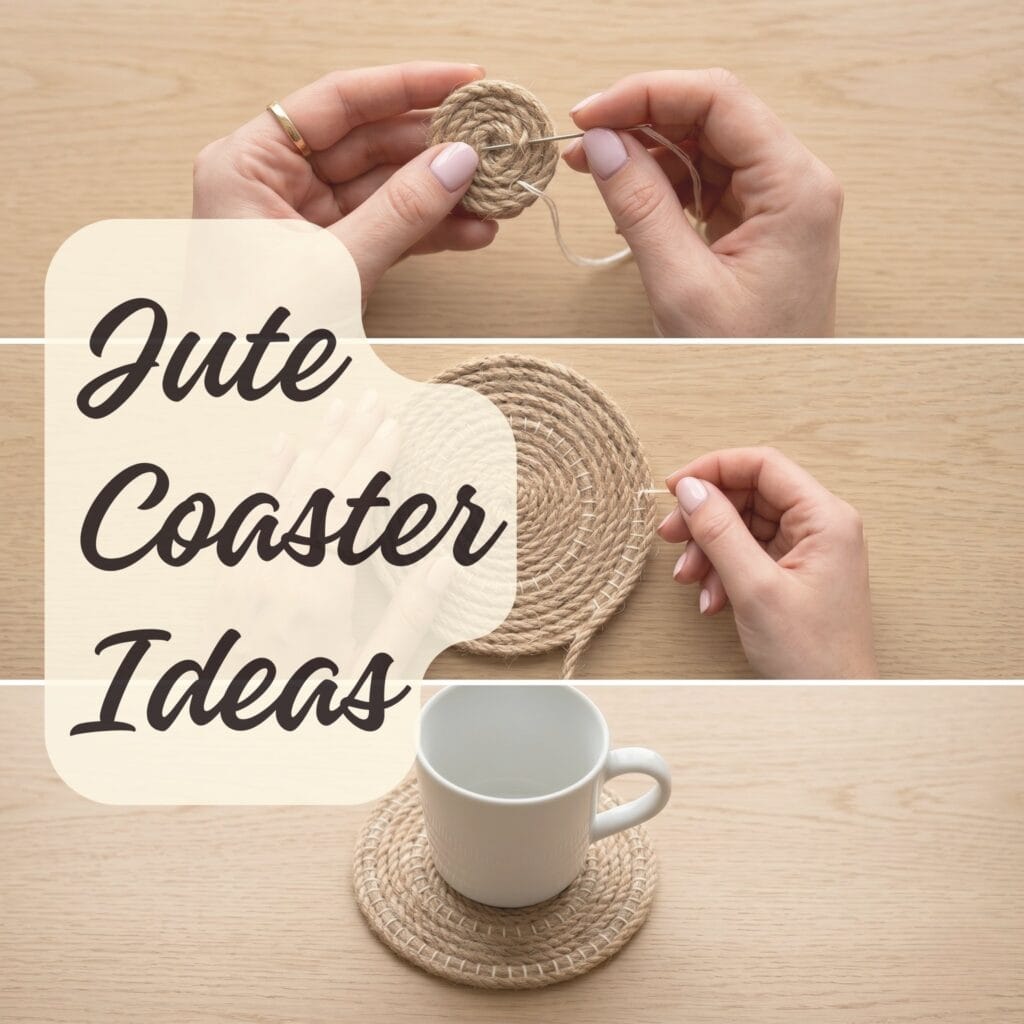
Bringing natural textures into your living space is easy. It instantly creates a warm, organic atmosphere. If you are searching for dynamic diy jute coasters, advanced crafting skills are definitely not required. Instead, a simple spool of utility rope can quickly transform into bohemian tableware. You just need to use basic coiling and binding techniques.
Affiliate Disclosure: This post contains affiliate links. As an Amazon Associate, I earn from qualifying purchases. If you buy through these links, I may earn a commission at no additional cost to you.
A handmade jute rope coaster offers a tactile, rustic aesthetic. You might already know the organic textures found in our guide to easy clay models. In that case, you will find working with fiber art deeply satisfying.
The Essential Toolkit for DIY Jute Coasters
Before beginning your first jute rope coaster tutorial, you should gather the right supplies. Certainly, this initial setup ensures your finished pieces are flat, durable, and clean.
- The Rope: 3mm to 5mm natural jute twine or twisted jute rope. Thinner rope allows for tighter, more intricate coils.
- The Adhesive: A heavy-duty hot glue gun with clear glue sticks. Use strong embroidery floss with a large tapestry needle.
- Decorative Accents: Matte acrylic paints, painter’s tape, small cowrie shells, raw wooden beads, and a fine detail brush.
Essential Materials & Tools
🪢 Shared Coaster Base Kit
- Natural 4mm Jute Rope — The primary material for tightly coiled round, square, and spiral coaster bases; 4mm rope gives a substantial rustic texture while remaining easy to shape. | Check Natural 4mm Jute Rope on Amazon
- Natural 3mm Jute Twine — A thinner option for smaller coasters, tighter spiral centers, and more intricate coiled patterns. | Check Price on Amazon
- Heavy-Duty Dual-Temperature Hot Glue Gun — Secures jute coils quickly and provides reliable adhesion for fringe, shells, beads, and lace accents. | View Heavy-Duty Dual-Temperature Hot Glue Gun on Amazon
- Fabric and Craft Scissors — Cleanly cuts jute rope, cotton fringe, embroidery floss, lace, and painter’s tape. | See Fabric and Craft Scissors on Amazon
🎨 Design-Specific Supplies (Optional per Variation)
- Cream Cotton Embroidery Floss — Creates the visible contrast blanket stitches used to secure classic spiral designs. | View Cream Cotton Embroidery Floss on Amazon
- Single-Strand Cream Cotton Macrame Cord — Soft, brushable cotton cord creates a full bohemian fringe around a structured jute center. | Find Single-Strand Cream Cotton Macrame Cord on Amazon
- Matte Terracotta Acrylic Paint — Provides the warm earthy pigment needed for masked half-moons and modern painted color blocks. | See Price on Amazon
- Matte Black Multi-Surface Acrylic Paint — Useful for crisp Scandi-style geometric lines, symbols, and minimal graphic motifs. | See Matte Black Multi-Surface Acrylic Paint on Amazon
- Pre-Drilled Cowrie Shells — Pre-drilled holes stitch straight onto the outer ring of design 5 with linen thread. | View on Amazon
- Unfinished Round Wooden Beads — Creates warm, tactile edging for textured bohemian coaster designs and can be left natural or painted. Choose beads with holes wide enough for the 4mm jute rope to pass through. | Find on Amazon
- Botanical Embroidery Floss Assortment — Provides leaf, stem, and flower colors for embroidered botanical motifs over a jute surface. | Check Botanical Embroidery Floss Assortment on Amazon
- French Lace Fabric — A circular cut of cream French lace covers the full coaster face for design 10. | Check Price on Amazon
- Large-Eye Blunt Tapestry Needles — The wide eye accommodates embroidery floss, while the blunt tip passes safely between coiled rope rows. | Find Large-Eye Blunt Tapestry Needles on Amazon
- Precision Detail Paintbrush Set — Includes fine round brushes for black geometric lines and flat brushes for clean painted half-moons. | See Price on Amazon
- Macrame Fringe Comb — Separates cotton cord fibers into a soft, even fringe around the coaster perimeter. | Explore Macrame Fringe Comb on Amazon
- Low-Tack Painter’s Tape — Masks sharp half-moon divisions, pastel blocks, and other graphic painted sections without pulling rope fibers. | Check Price on Amazon
- Linen Thread — Strong linen thread stitches the pre-drilled cowrie shells evenly around the outer ring of design 5. | Explore Linen Thread on Amazon
- Pastel Cotton Yarn — Soft sage and pastel yarn wraps the coiled rope for the color-blocked look in design 6, replacing paint. | Explore Pastel Cotton Yarn on Amazon
- Metal Ruler — A straight metal edge presses the folded rope into the square layout for design 7. | Explore Metal Ruler on Amazon
- Matte Decoupage Glue — Clear matte decoupage glue bonds the lace overlay in design 10 and dries without shine. | Explore Matte Decoupage Glue on Amazon
- Clear Hot Glue Sticks — A clear, durable adhesive refill for building coils and attaching dimensional decorations. | View on Amazon
Optional Studio Upgrades
Never required to finish the projects above — convenience upgrades for makers who want them.
📦 Beginner Project Kits & Coordinated Bundles
Coordinated bundles that gather the core supplies in one order.
- Jute Rope Coaster Making Kit — A coordinated optional kit for first-time makers who want jute, adhesive supplies, and project guidance together. | View on Amazon
10 DIY Jute Coaster Projects You Can Make
Supplies Needed: Natural 4mm Jute Rope, Clear Hot Glue Sticks, Heavy-Duty Dual-Temperature Hot Glue Gun, Fabric and Craft Scissors
The Base Technique Behind All 10 Projects
Every design on this list coils from the same center, but rows lock in two different ways — follow the route your project’s method calls for:
Roll the very tip of the rope into a tight central circle. Glued construction: build coil by coil with a short line of hot glue under each new row, pressing each row down before the glue sets — designs 3, 5, 6, 7, and 10 build this way, and design 2 starts from an already-glued coaster. Stitched construction: pass a needle through each adjacent coil as you spiral outward instead of gluing — designs 1 and 9 work this way. Designs 4 and 8 start from a plain completed coaster, so follow each project’s own list. Either way, keep every round snug against the last so the disc stays flat, and keep your tension even — pulling too tightly makes the coaster cup upward instead of lying flat. Design 3 starts from a small 3-inch circle, and design 7 shows how to fold a 1-inch end for square shapes. Finished diameter depends on your rope thickness and how many rounds you coil, and the projects below each work as their own coaster. Raised shells, beads, and fringe make uneven tops, so these designs suit lightweight mugs and stable cups better than tall, stemless drinkware.
1. Classic Spiral Coaster with White Stitching
Supplies Needed: Natural 4mm Jute Rope, Cream Cotton Embroidery Floss, Large-Eye Blunt Tapestry Needles, Fabric and Craft Scissors
Traditional fiber arts celebrate structural details. Because of this, exposing the stitches on a jute rope coaster yields an artisan look. The contrasting cream thread breaks up the coarse texture of the rope. It is perfect for classic diy jute coasters.
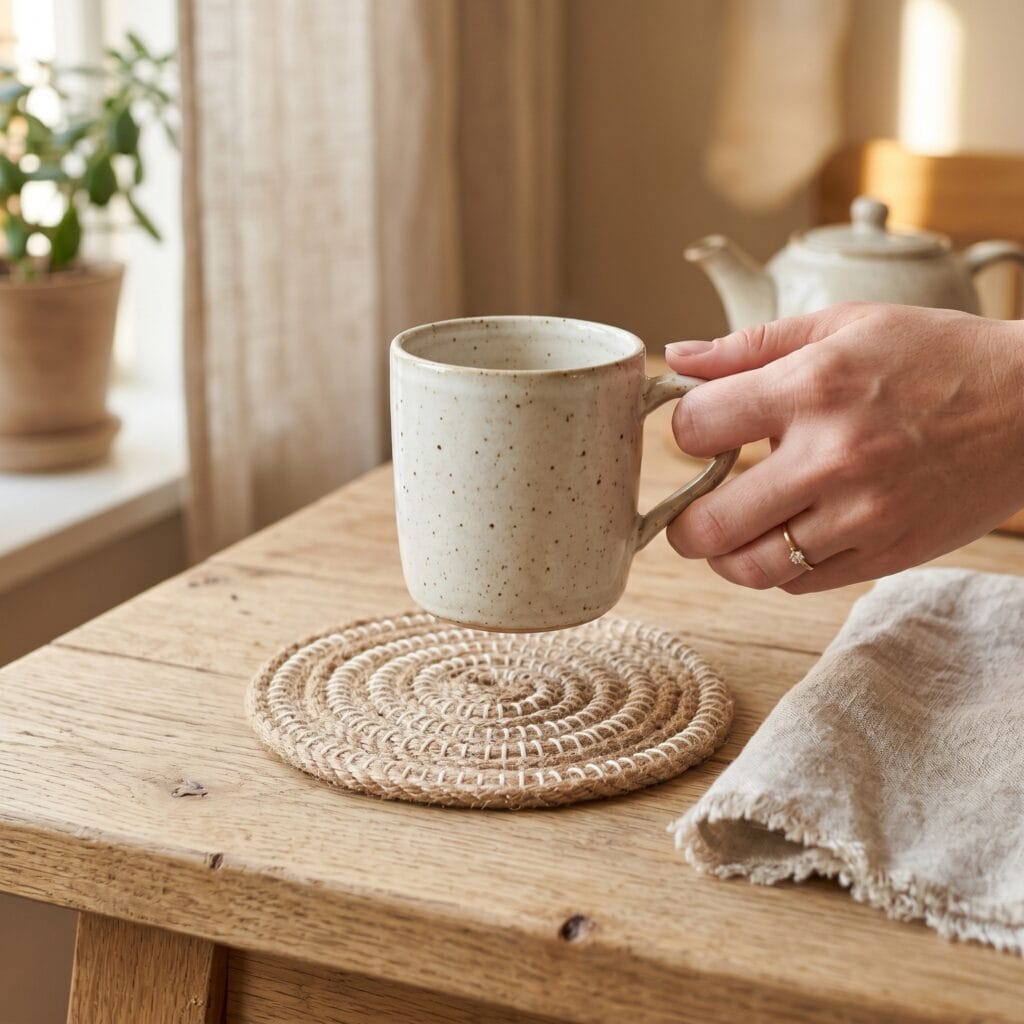
- What you need: 4mm jute rope, cream embroidery floss, a large tapestry needle.
Quick Steps:
- First, coil the very tip of the rope into a tight central circle.
- Next, pass the needle through the adjacent coils to lock the core.
- Afterward, continue wrapping the rope outward in a spiral.
- Finally, execute a neat blanket stitch across each row to bind them together securely.
Pro-Tip: Make sure to pull each stitch with even tension. Otherwise, if you pull too tightly, the coaster will cup upward instead of laying perfectly flat.
2. Terracotta Painted Half-Moon Designs (Painted DIY Jute Coasters)
Supplies Needed: Natural 4mm Jute Rope, Matte Terracotta Acrylic Paint, Low-Tack Painter’s Tape, Precision Detail Paintbrush Set
You can introduce a pop of modern color to your space. To do this, simply mask off your finished diy jute coasters with painter’s tape. This step creates a crisp, contemporary layout. This look mirrors the earthy tones found in our hand-painted terracotta pots tutorial.
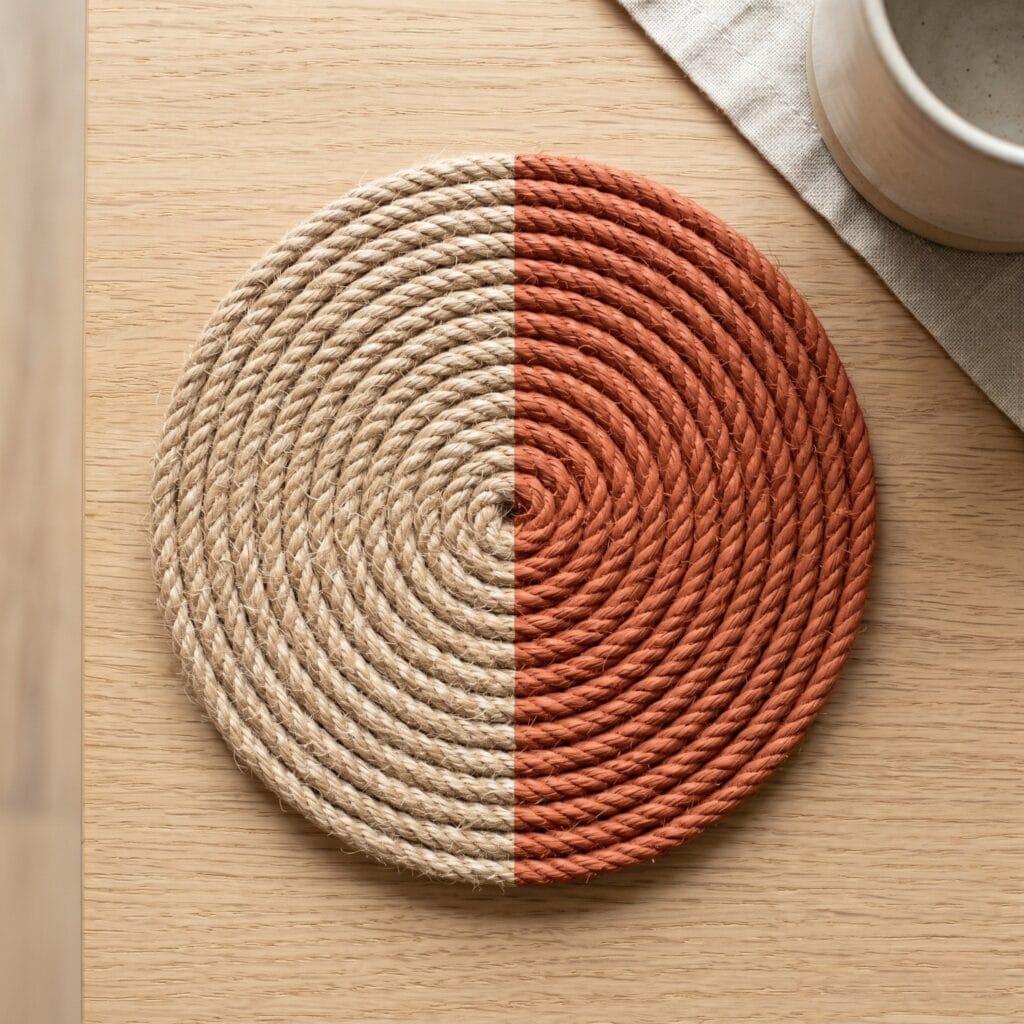
- What you need: A completed glued jute coaster, matte terracotta acrylic paint, painter’s tape, a flat brush.
Quick Steps:
- Initially, wait for your coiled coaster to dry completely.
- Then, place a strip of painter’s tape exactly across the center.
- After that, paint one half with a solid layer of terracotta paint.
- Meanwhile, ensure the pigment sinks deep into the rope fibers.
- Finally, peel the tape away while the paint is damp.
3. Fringed Macrame Border Jute Coaster
Supplies Needed: Natural 3mm Jute Twine, Single-Strand Cream Cotton Macrame Cord, Heavy-Duty Dual-Temperature Hot Glue Gun, Clear Hot Glue Sticks, Macrame Fringe Comb
This unique approach combines two iconic bohemian materials. It blends a structured jute center with a wonderfully soft, combed cotton perimeter. You get texture-rich diy jute coasters.
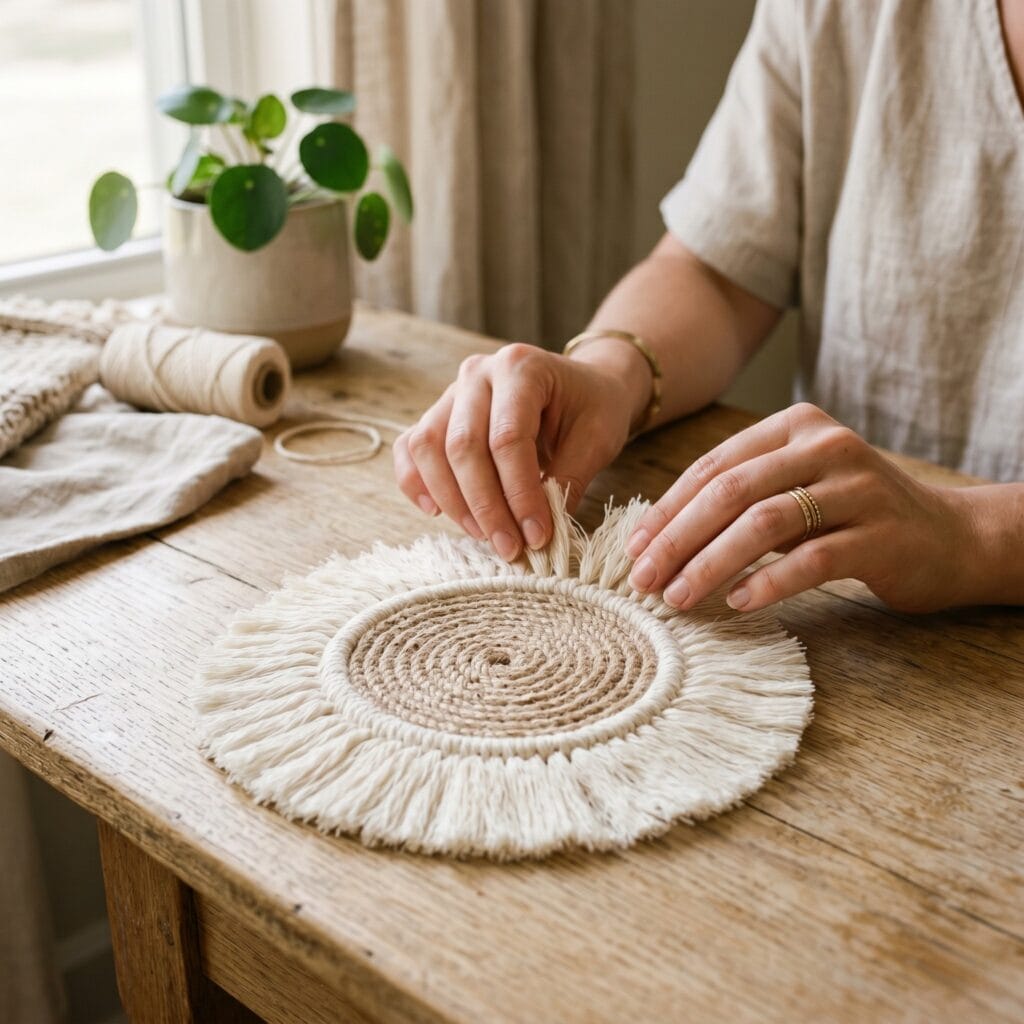
- What you need: 3mm jute rope, 3mm single-strand cream cotton macrame cord, hot glue.
Quick Steps:
- To begin, coil your jute rope into a small 3-inch circle and secure it with hot glue.
- Next, cut dozens of 2-inch segments of cotton cord.
- After that, fold each segment in half.
- Then, glue the loops securely along the outer edge of the jute circle.
- Finally, brush through the cotton with a fine comb to create a fluffy fringe.
4. Scandi Black Geometric Line Patterns (Minimalist DIY Jute Coasters)
Supplies Needed: Natural 4mm Jute Rope, Matte Black Multi-Surface Acrylic Paint, Precision Detail Paintbrush Set
Some crafters prefer a Scandinavian approach to bohemian decor. Adding sharp lines to your diy jute coasters provides a graphic contrast.
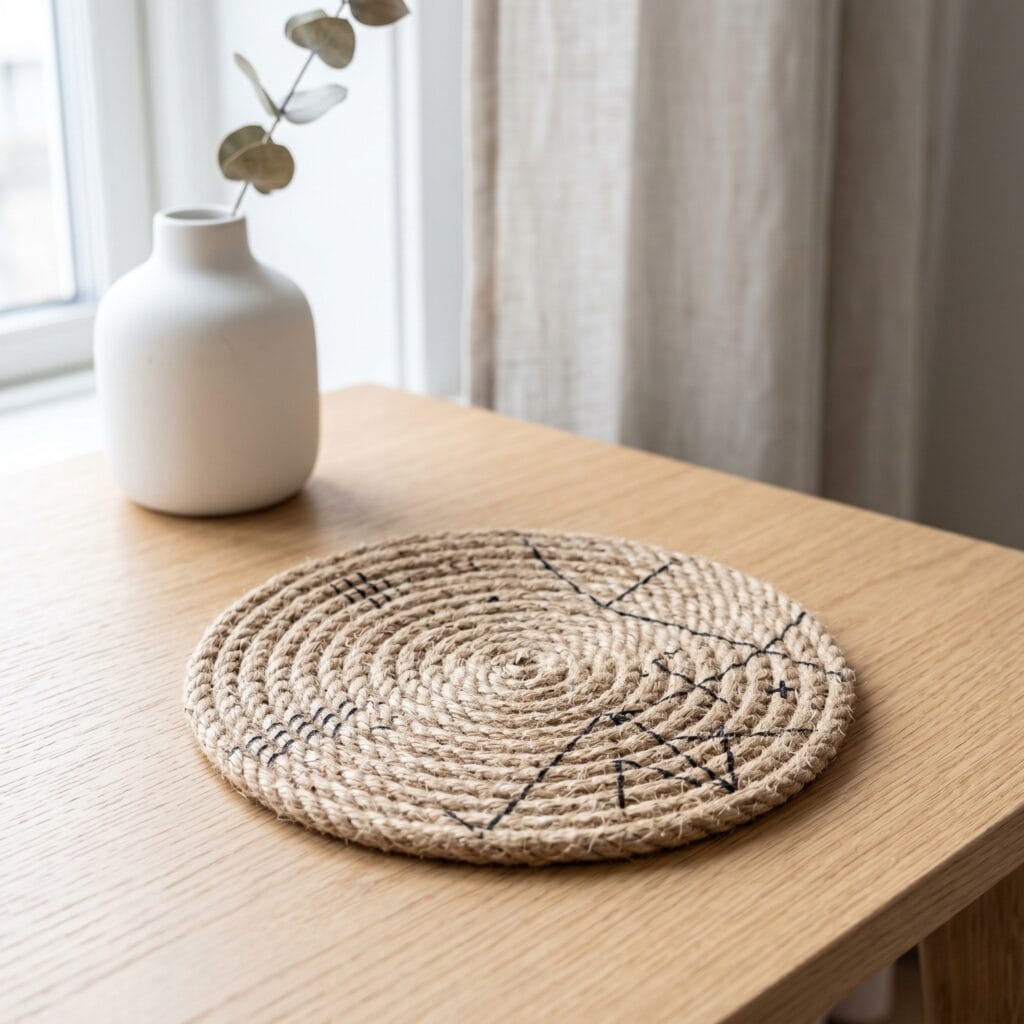
- What you need: A plain jute coaster, matte black multi-surface paint, an ultra-fine detail brush.
Quick Steps:
- First, ensure your jute surface is smooth and clean.
- Next, load your fine brush with a minimal amount of black paint.
- Then, gently paint fine, delicate geometric hashes, small triangles, or a clean plus sign (+) directly over the rustic coils.
5. Cowrie Shell Boho Fringe Coaster
Supplies Needed: Natural 4mm Jute Rope, Pre-Drilled Cowrie Shells, Linen Thread, Heavy-Duty Dual-Temperature Hot Glue Gun, Clear Hot Glue Sticks
Nothing captures the relaxing energy of beach-boho styling quite like genuine seashells. This coastal jute rope coaster looks premium. It works perfectly as a summer catch-all tray.
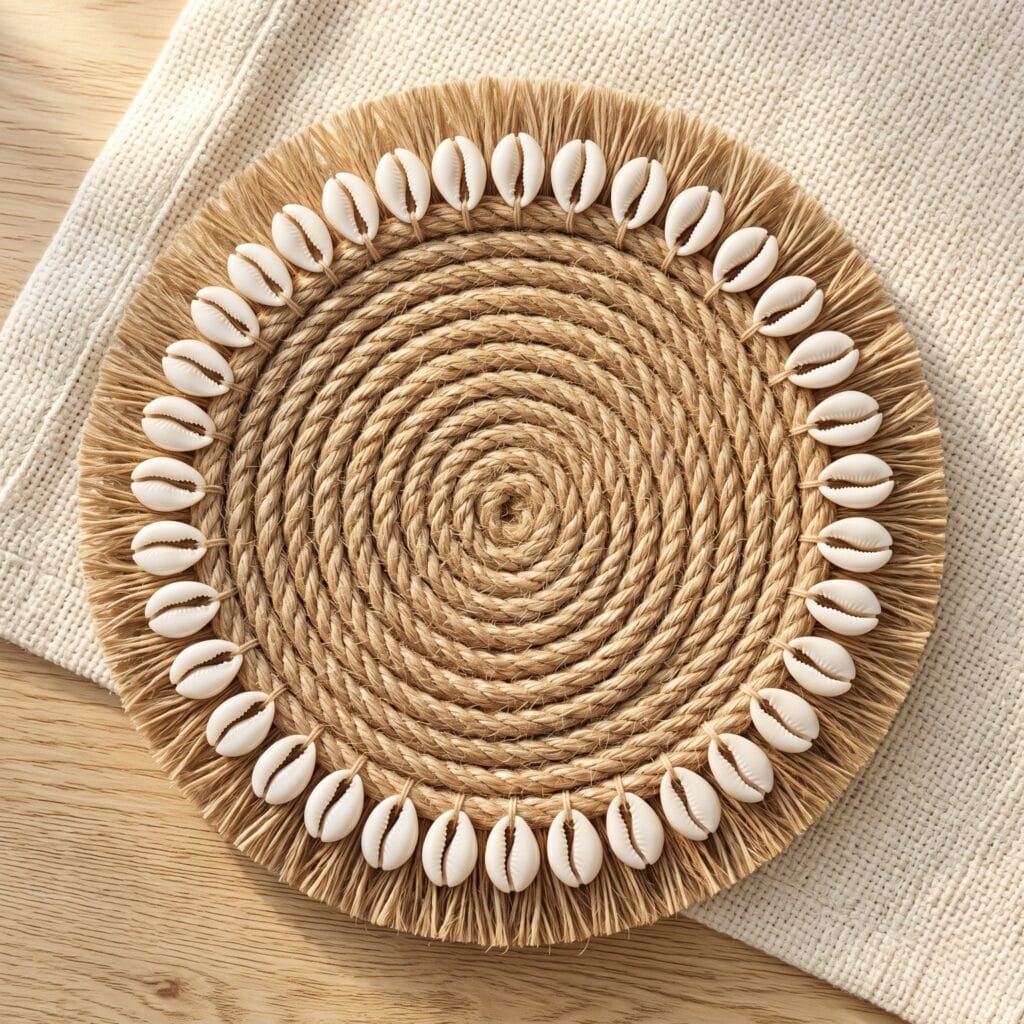
- What you need: Jute rope, 12 small pre-drilled cowrie shells, strong linen thread.
Quick Steps:
- First, construct a standard coiled jute coaster using hot glue.
- Afterward, use your linen thread to stitch the cowrie shells evenly around the outermost ring of the rope.
- Meanwhile, space them roughly half an inch apart.
6. Color-Blocked Pastel Designs (Structured DIY Jute Coasters)
Supplies Needed: Natural 4mm Jute Rope, Pastel Cotton Yarn, Heavy-Duty Dual-Temperature Hot Glue Gun, Clear Hot Glue Sticks
You do not have to paint the surface after coiling. Instead, this advanced technique introduces different colored fibers directly into the winding process. This creates a seamless, modern style for your diy jute coasters.
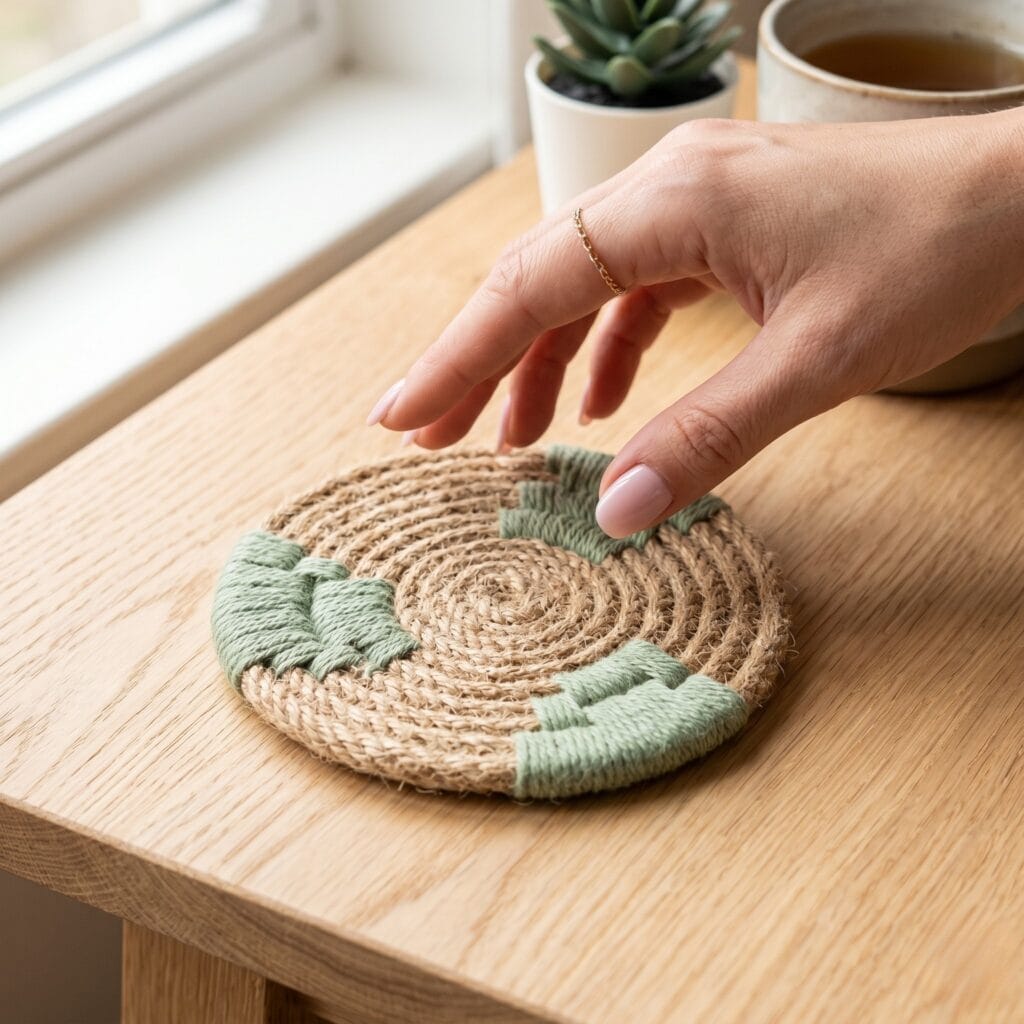
- What you need: Jute rope, soft sage green yarn or pastel pink embroidery thread.
Quick Steps:
- To start, coil your natural jute rope normally.
- However, after three rows, wrap a section of the rope tightly with your sage green yarn.
- Do this before gluing down the next spiral.
- This creates blocks of color built right into the structure.
Jute Rope Coaster Making Kit
A coordinated optional kit for first-time makers — check the listing for exact contents before ordering.
I earn a commission if you make a purchase, at no additional cost to you.
7. Square Coiled Minimalist Mat
Supplies Needed: Natural 4mm Jute Rope, Heavy-Duty Dual-Temperature Hot Glue Gun, Clear Hot Glue Sticks, Metal Ruler
You can move away from traditional circular shapes for a new jute rope coaster. To do this, try bending your rope into crisp angles. It offers a modern, geometric alternative.
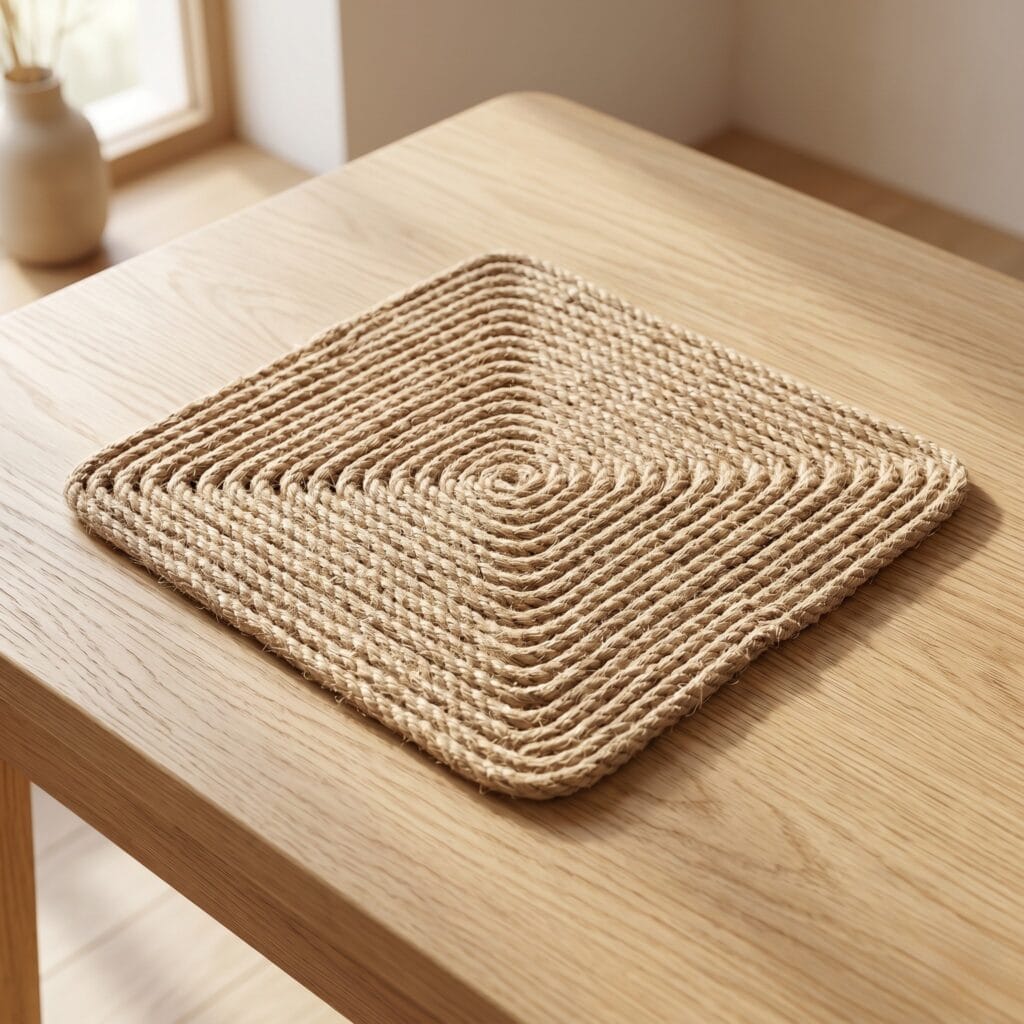
- What you need: 4mm jute rope, hot glue, a metal ruler.
Quick Steps:
- To start, bend the end of your rope into a small 1-inch straight line.
- Then, fold it sharply back on itself.
- Afterward, continue folding and gluing the rope around this central core.
- Finally, use a ruler to press the edges into a perfect square layout as you expand.
8. Wooden Bead Trimmed Edges (Textured DIY Jute Coasters)
Supplies Needed: Natural 4mm Jute Rope, Unfinished Round Wooden Beads, Heavy-Duty Dual-Temperature Hot Glue Gun, Clear Hot Glue Sticks
Certainly, adding raw timber accents to your diy jute coasters is a fantastic idea. It introduces a three-dimensional silhouette.
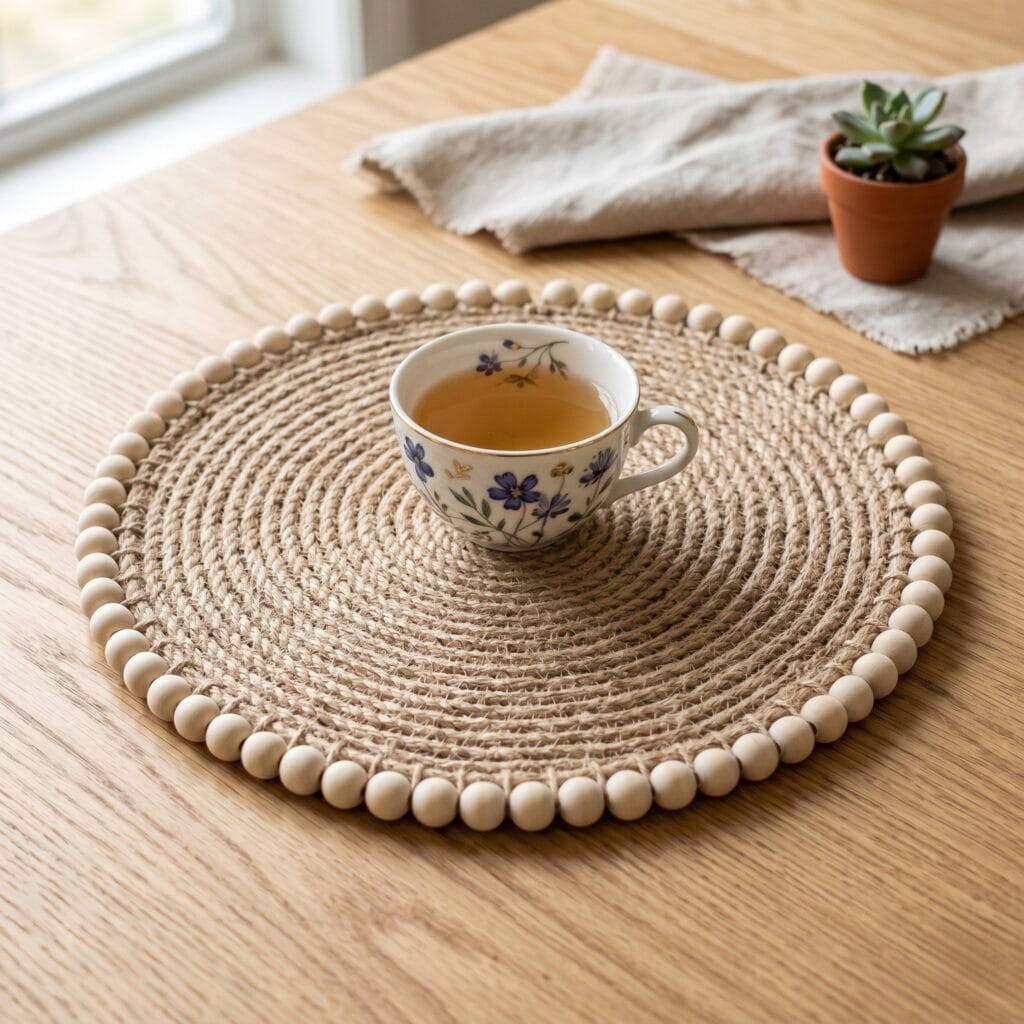
- What you need: Coiled jute coaster, small 6mm unvarnished wooden beads with holes wide enough for the 4mm jute rope, hot glue.
Quick Steps:
- Initially, complete your main jute spiral structure.
- Next, string your raw wooden beads onto the final outer tail of the jute rope.
- After that, do this before gluing that last row down around the perimeter of the coaster.
9. Embroidered Botanical Jute Coaster
Supplies Needed: Natural 3mm Jute Twine, Botanical Embroidery Floss Assortment, Large-Eye Blunt Tapestry Needles
You might enjoy the rhythmic precision of needlework. If so, treating a flat jute rope coaster as a canvas for simple embroidery is a rewarding process.
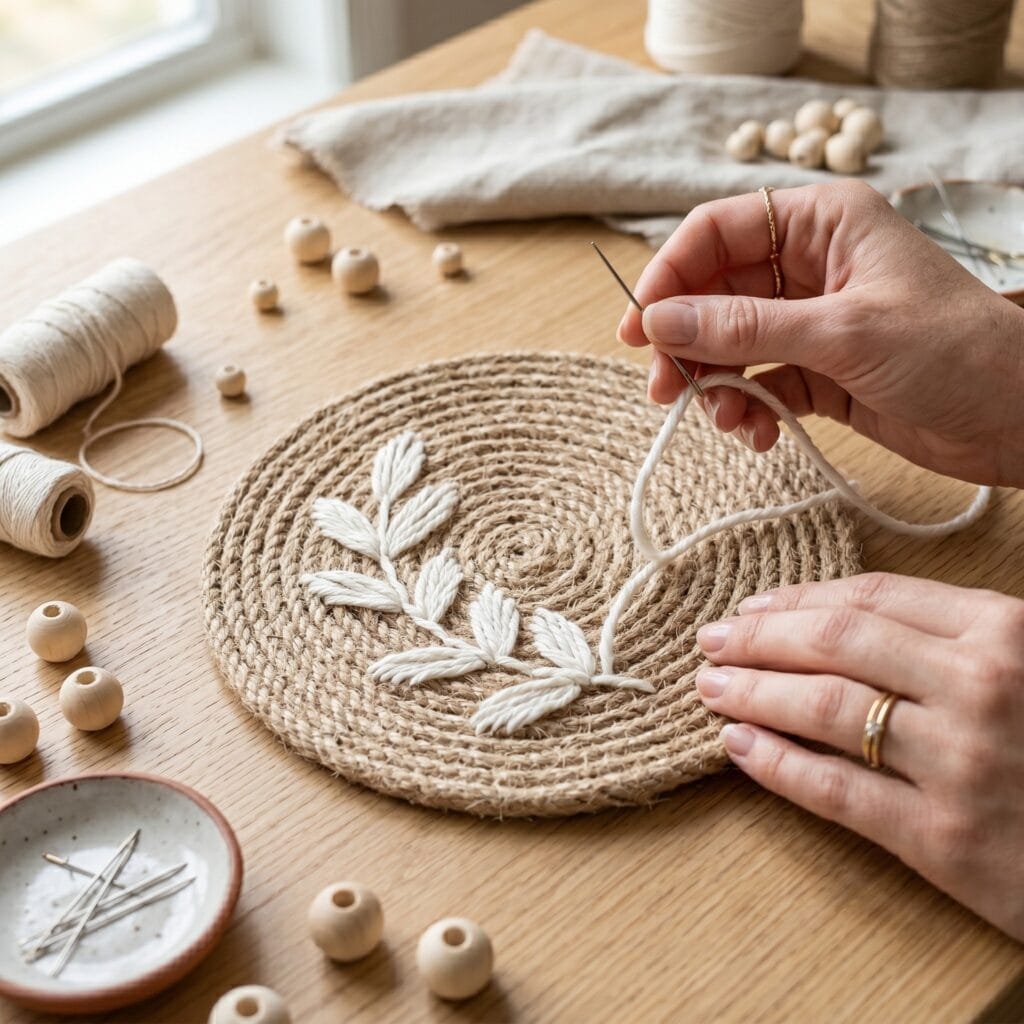
- What you need: A completed stitched jute coaster, botanical embroidery floss, a tapestry needle.
Quick Steps:
- To begin, map out a very simple leaf silhouette in your mind.
- Then, use your needle to thread the floss up and down through the jute coils.
- Finally, execute simple straight stitches to form a minimalist botanical sprig.
10. Lace-Overlay Romantic Aesthetic (Elegant DIY Jute Coasters)
Supplies Needed: Natural 4mm Jute Rope, Heavy-Duty Dual-Temperature Hot Glue Gun, Clear Hot Glue Sticks, French Lace Fabric, Matte Decoupage Glue
This is a vintage-inspired interpretation. It combines rugged utility rope with delicate, intricate fabrics. You get a high-contrast feminine finish on these diy jute coasters.
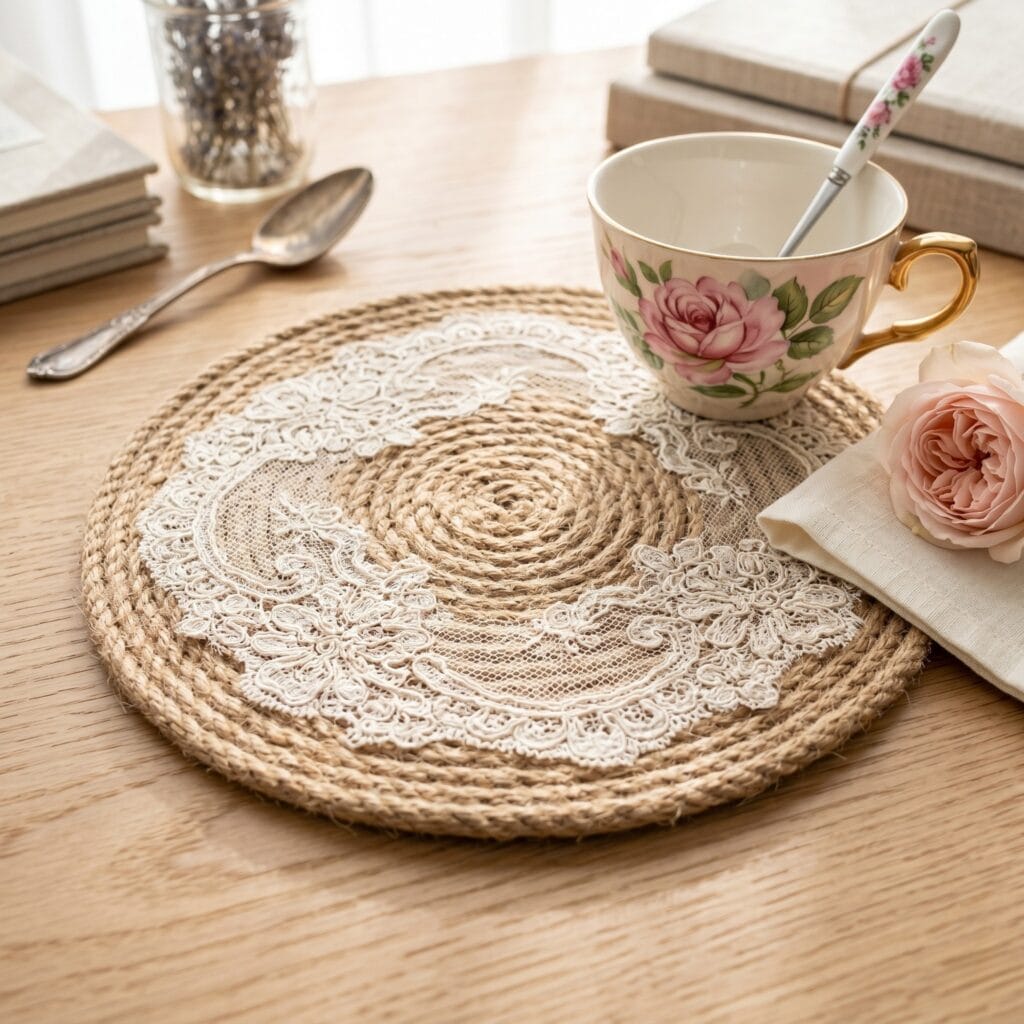
- What you need: Jute rope, a scrap of cream French lace fabric, clear matte decoupage glue.
Quick Steps:
- First, assemble a flat jute coaster using your glue gun.
- Next, cut a circular piece of lace.
- Meanwhile, make sure it perfectly matches the diameter of your coaster.
- Finally, brush a thin layer of decoupage glue over the jute.
- After that, press the lace down firmly and let it dry completely.
Important Crafting Safety Notes
These ten projects use hot glue, scissors, needles, paint, and small decorative parts. Four precautions cover the actual risks:
• Hot-glue burns: The nozzle and fresh glue stay hot. Work in short touches, hold pieces by the rope rather than the wet glue, and let each glued row cool before pressing it with your fingers.
• Scissors and tapestry needles: Both stay sharp enough to puncture skin. Cut rope ends down toward the table instead of toward your free hand, and lay the needle flat between stitches so it cannot roll off the work surface.
• Paint ventilation: Open a window while you use acrylic paint and painter’s tape, and let painted pieces dry somewhere pets and small children cannot reach them.
• Small shells and beads: Loose cowrie shells and wooden beads are choking hazards for young children and pets. Keep offcuts off the floor and store leftover shells and beads in a sealed bag between sessions.
For more detailed guidance on safe crafting practices, liability disclosures, and website usage, please review our Terms and Conditions.
“Which of these Beautiful DIY Jute Coasters You Can Make ideas are you excited to try first, or do you have a creative tip of your own to share? Drop a comment below—I’d love to hear your thoughts and see what you create!”